-
Solutions

Timesheets Management
Stop leaving money on the table. Procxo's AI integrated time tracking operates in the background.
Project Management
Procxo connects all the work your team does with the money your firm makes. Manage your deadlines, assignments, and budgets.
Invoice Management
Turn days of manual reconciliation into a single click. Procxo works in the background to automatically.
Contract Lifecycle Management
Accelerate negotiations, govern service level agreements (SLAs), and execute agreements flawlessly. Procxo unifies drafting.
-
Resources
Blogs
Read our latest insights, articles, and updates. Stay informed with industry trends and perspectives.
Case Studies
Explore real examples of our work and impact. See how we solve complex challenges.
Why Procxo
Built to streamline projects, billing, and financial workflows. Helping service professionals work smarter and grow faster.
FAQs
Browse answers to frequently asked questions. Find clear information about our services and processes.


KEY TAKEAWAYS
✓
✓
✓
✓
Summary:
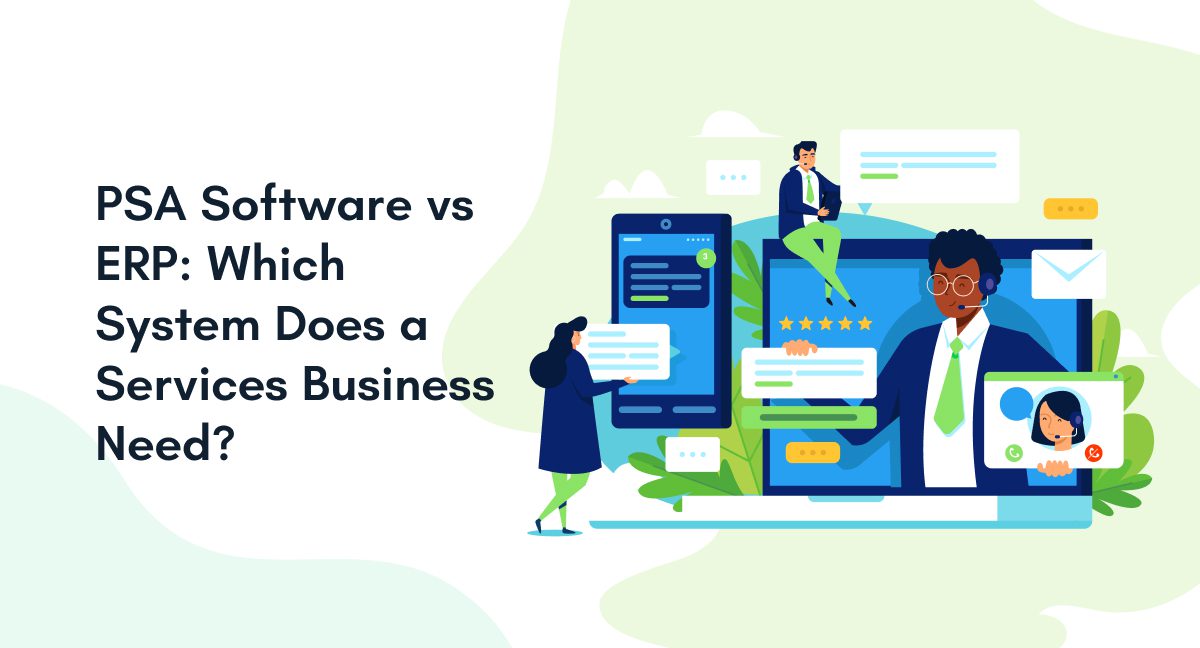
PSA software vs ERP is not about which system is better. It is about where your business breaks. A PSA platform protects margins during delivery. ERP protects financial control after it. Growing firms succeed when these business management systems share data without manual re-entry.
Your firm has outgrown spreadsheets. Projects overrun quietly, timesheets arrive late, and finance spends the first week of every month matching invoices to hours. At this stage, most leaders face the same decision, namely, PSA software vs ERP.
Both are business management systems, but they answer different questions. One tells you whether a project is profitable while it runs. The other tells you whether the company is consolidated, compliant, and in control. This guide skips the feature tour and helps you match the system to where your business actually loses money.
What Is the Difference Between ERP and PSA?
PSA (professional services automation) software manages client delivery like projects, resource scheduling, time tracking, and project billing. ERP (enterprise resource planning) software manages company-wide operations like accounting, procurement, HR, and financial reporting. PSA measures the project. ERP measures the business.
| Feature | PSA Software | ERP |
| System of record for | Projects, hours, utilization | General ledger, entities, vendors |
| Primary users | Delivery leads, project and resource managers | Finance, operations, executives |
| Unit of measurement | Project and client | Company and legal entity |
| Profitability view | Per project, in real time | Per entity, after month-end close |
| Typical rollout | Weeks to a few months | Several months to over a year |
| Best fit | Firms that sell time and expertise | Firms with complex finance or product lines |
Overlap exists, since many ERPs include project modules and many PSA tools invoice, but the depth sits in different places.
Where Does a Services Business Actually Lose Margin?
Services firms lose margin in two places. During delivery (unbilled hours, over-servicing, poor staffing) and after delivery (slow close, billing errors, weak controls). Delivery leaks call for PSA software. Post-delivery leaks call for ERP.
Every engagement follows the same chain, namely, sold, staffed, delivered, billed, recognized, reported. Map your last three margin surprises onto it.
Leaks during delivery
- Hours worked but never logged or billed
- Senior people staffed on junior work
- Scope creep spotted only at month-end
Leaks after delivery
- Invoices rekeyed from timesheets into accounting
- Manual revenue recognition and a slow multi-entity close
- Audit trails scattered across email and shared drives
The cost adds up. PMI’s Pulse of the Profession found organizations wasted almost 12% of their project investment due to poor project performance.
When Is a PSA Platform the Right Call?
Choose a PSA platform when revenue depends on billable hours, retainers or fixed-fee projects, and your biggest problems are staffing, utilization and project profitability.
- Revenue is tied to people’s time rather than products
- Resource availability lives in one manager’s head
- You learn a project’s margin only after it closes
- Delivery teams, not finance, will use the system daily
- You need value within a quarter, not a year
For IT services firms, consultancies and agencies, PSA software is usually the faster path to control.
When Does ERP for Service Businesses Make More Sense?
ERP for service businesses makes sense when financial complexity, not delivery, is the obstacle, namely, multiple entities or currencies, complex revenue recognition, heavy procurement or investor-grade reporting.
- You report across several legal entities, regions or currencies
- Revenue recognition rules are complex or audited
- Vendor contracts and subcontractor spend are growing fast
- You also sell products alongside services
That last point matters. A hybrid firm with an online storefront needs capabilities such as SAP Commerce personalization or AI ecommerce search, which sit in a commerce layer connected to the ERP. A PSA tool will not cover them.
ERP also carries more delivery risks. A McKinsey and University of Oxford study of more than 5,400 IT projects found large IT projects run 45% over budget on average. Scope your ERP for service businesses before you commit.
Do You Need Both PSA and ERP?
You need both when delivery and finance each need specialist depth. PSA software owns projects, time and billing inputs. ERP owns the ledger, payroll, and consolidation. The integration between them decides whether the setup works.
The trouble is rarely the system. It is the gap between them. Approved hours sit in one tool, invoices get rekeyed into another, and contracts live in a third, so finance closes the month on data it cannot fully trust.
Procxo closes that gap without replacing your business management systems. It integrates with leading ERPs and finance tools and brings timesheet management, project management, invoice management and contract lifecycle management into one flow. Data entered once moves in real time, so there is no double data entry, and every record stays audit ready.
How Is AI Changing the PSA vs ERP Decision?
AI makes connected data more valuable. Forecasting, margin alerts and anomaly detection only work when project and financial data share one accurate record.
PSA tools now use AI to forecast resource demand and flag projects heading for overrun. ERP uses it to catch anomalies and speed up the close. If timesheets, invoices, and contracts disagree, AI amplifies the error. Fix the data flow first, the AI value follows.
5 Questions to Decide Between PSA Software vs ERP
- How do you earn revenue? Billable time or retainers point to PSA. Products or mixed revenue point to ERP or both.
- Where did your last margin surprise come from? A project points to PSA. The close or audit point to ERP.
- How many legal entities do you report on? One may need only PSA. Several need ERP.
- Who will use the system daily? Delivery teams point to PSA. Finance points to ERP.
- How fast do you need value? This quarter points to PSA. A year-long rollout is acceptable for ERP.
Mostly PSA answers? Start there. A mix? Plan for both and plan the integration from day one.
Conclusion
- PSA software runs delivery; ERP runs the business.
- Diagnose your margin loss before you compare vendors.
- Choose a PSA platform when people, time, and projects drive revenue.
- Choose ERP when entities, compliance and consolidation drive complexity.
- Run both only with a clean integration, or the gap becomes your next loss.
FAQs
Yes, for many small and mid-sized firms with one entity and simple accounting. Firms with multiple entities, complex revenue recognition, or audit demands still need ERP.
Not always. Add ERP when finance becomes the obstacle, namely, slow closes, multi-entity consolidation or compliance reporting your tools cannot produce.
No. Agencies, engineering and architecture firms, legal practices and any business that bills for time and expertise use it.
Usually when it adds legal entities, enters new countries, raises outside investment, or faces audits that require consolidated financials.
Yes. Approved timesheets, project budgets, invoices, and contract terms should sync. An integration layer like Procxo keeps them aligned in real time.